
Your Cart
Chocolate Packaging Trays: How to Choose Inserts That Protect Truffles and Pralines Before Peak Season
Chocolate is one of the least forgiving products a confectionery brand can ship. It marks when it slides, blooms when it sweats, absorbs nearby odours, and loses value the moment a fingerprint lands on a hand-dusted surface. Yet the component that touches the product directly — the moulded tray inside the box — is often specified last, after the box, the sleeve, and the ribbon have already been decided.
With peak gifting season now on every confectionery calendar, brands are locking in holiday packaging. The tray decision made in the next few weeks determines how pieces arrive in December: aligned and pristine, or loose and marked. This article explains what a chocolate packaging tray has to do, the design details that separate a good one from a generic insert, and the questions worth asking a tray supplier before the season compresses everyone's lead times.
Why Chocolate Punishes the Wrong Tray
Four failure modes show up repeatedly when chocolate is packed in a tray that was not designed for it.
Movement and marking: A cavity that is too wide lets pieces rock in transit. Every tilt scuffs the shell, smudges cocoa-dusted surfaces, and transfers colour between decorated pieces. The tray's job is to immobilise each piece — not merely to occupy the same box.
Bloom pressure: Chocolate's cocoa butter migrates with temperature swings, and poor handling accelerates the visible bloom that reads as "old" on the shelf. Trays cannot replace cold-chain discipline, but tight cavities reduce the handling that makes it worse.
Moisture and odour: Condensation inside a sealed box clouds both the chocolate and the tray, and plastics differ in how readily they carry odours. Food-grade material with the right finish keeps the presentation clean.
Presentation decay: A premium assortment sells on the moment the lid opens. Misaligned cavities and warped trays flatten that moment — and the price the product can command.
What a Moulded Chocolate Tray Actually Does
The tray is the interface between a fragile, fat-rich product and everything around it. Done well, it performs four jobs at once.
It cradles each piece individually: Thermoformed cavities hold every praline at the same height and spacing, so the assortment looks composed when the lid opens — and nothing migrates during transport.
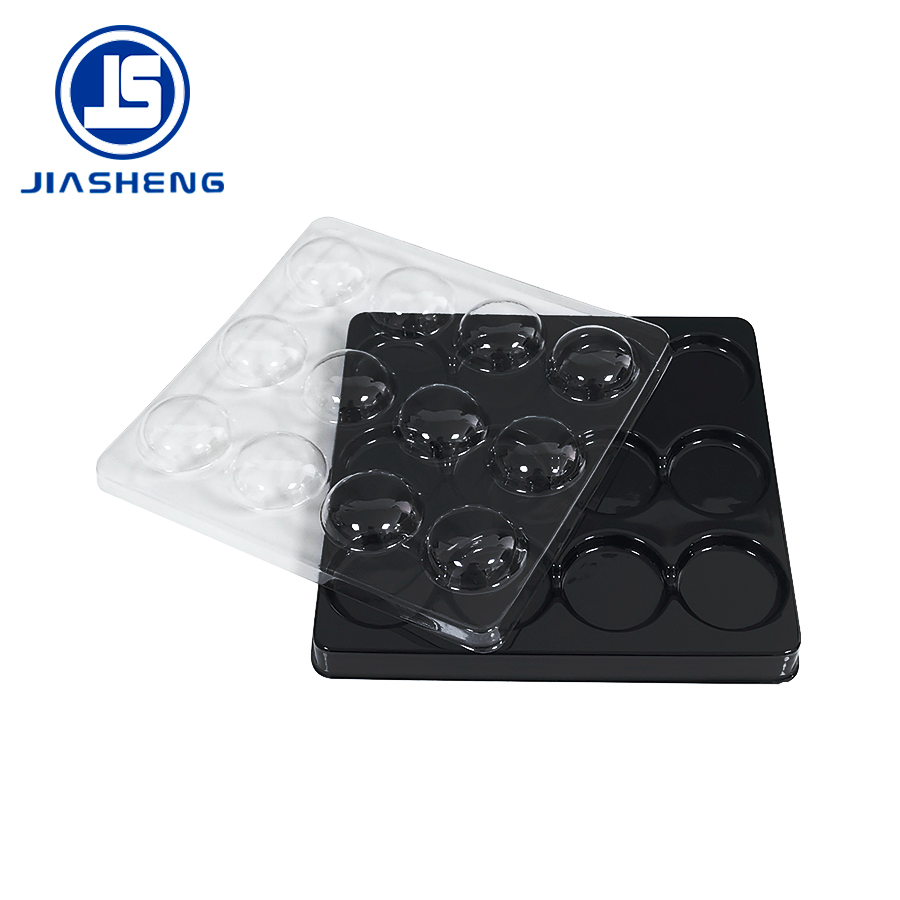
It carries the visual weight: A clear tray works with a windowed lid to show the product; a black tray gives dark chocolate and dusted pieces the contrast that photographs well in retail and social channels. The same geometry, two very different merchandising statements.
It structures the assortment: Cavity count and layout decide how many varieties fit, whether the mix can change per season, and whether one tray can serve several SKUs.
It protects without adding bulk: A formed tray of a fraction of a millimetre replaces loosefill and dividers, keeping shipping volume and box size down.
Cavity Design: The Details That Decide the Outcome
Generic inserts fail in the details. Five are worth specifying explicitly.
Cavity geometry versus piece shape: Round cavities suit truffles and spherical pralines; squares and rectangles need corner relief so sharp moulded edges do not chip. The cavity should touch the piece at its widest point, not at its decoration.
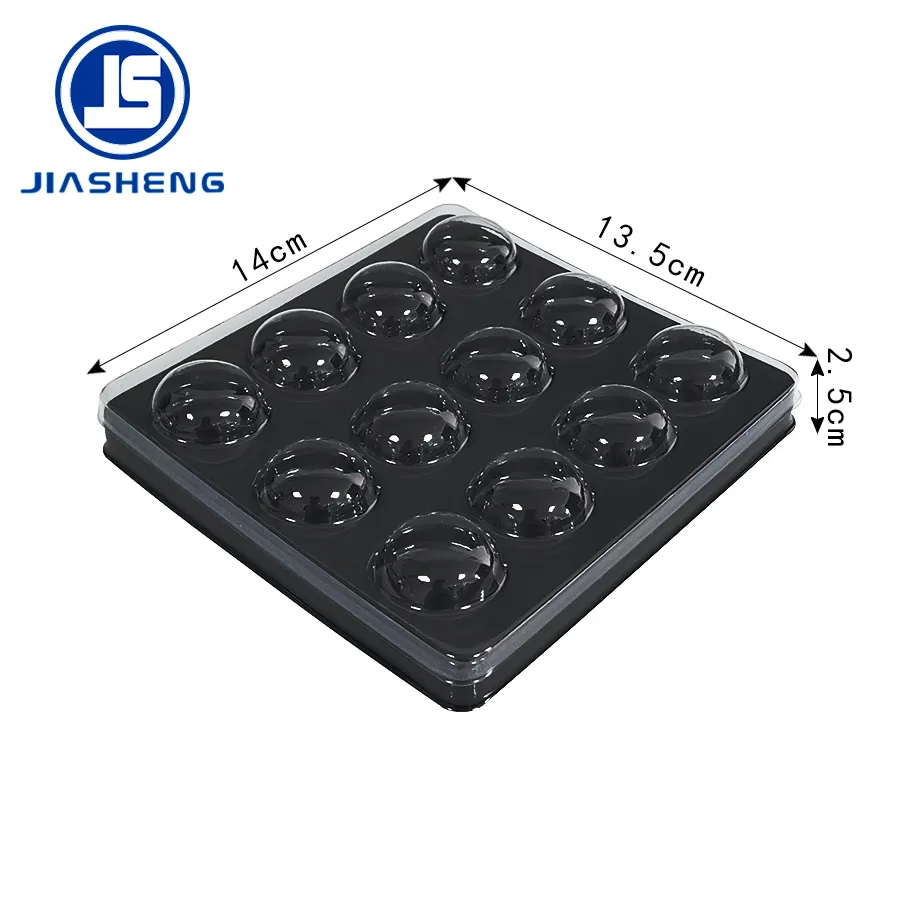
Depth and lid clearance: Tall pieces need a cavity deep enough that the lid never presses the decoration — while staying shallow enough to pop the piece out cleanly. A 2.5 cm depth, as in the twelve-cavity insert above, fits most standard praline heights with clearance.
Release taper: Cavities need draft so pieces release with a gentle tilt. The test is simple: invert the tray and every piece should leave without a fingernail.
Layout and count: Six, nine, and twelve counts cover most retail gift formats, and the tray above — twelve cavities on a 14 × 13.5 cm footprint — is a common reference point. Mixed assortments may need asymmetric layouts, which is a moulding decision rather than an afterthought.
Stacking and box fit: The tray footprint should locate positively inside the box, and nested trays should not interlock so tightly that cavities scuff each other in transit.
Material Selection for Direct Chocolate Contact
Because the tray touches food directly, material is a compliance decision as much as an aesthetic one.
Food-contact certification first: The material must be certified for direct contact with high-fat foods, with documentation for the finished tray rather than the resin. This is a screening question, not a differentiator.
Clear grades for visibility: Rigid clear PET-family materials give the transparency a windowed gift box needs, and stay within the PET recycling stream that most markets already collect.
Dark grades for contrast: Black or deep-toned trays make dusted and decorated pieces stand out and hide handling marks in service — a common choice for premium assortments and hotel amenities.
Odour neutrality: Confectionery absorbs surrounding smells. Ask what the material grade is specified for odour performance, particularly for long retail runs.
The same logic extends across the confectionery and dessert range — from food-grade plastic chocolate trays to the golden oval dessert blisters covered in our article on custom disposable dessert packaging.
Planning Seasonal and Gifting Programs
Holiday assortments are where tray planning pays — or costs. Three realities shape the timeline.
Custom cavities mean custom tooling: A signature piece size usually needs its own mould. Tooling and first samples take weeks, so a December launch effectively has a September decision date — which is why brands that start tray conversations now ship calmly in November.
Standard cavities buy speed: Where the assortment can be built around a proven cavity count and footprint, a standard tray moves from order to shipment far faster — often the pragmatic route for a first seasonal run.
Samples settle disputes: Print mock-ups do not answer whether a salted piece releases cleanly or a dome survives the drop test. Real samples on real product do, and customization services typically include exactly this iteration loop before tooling is finalized.
Five Questions to Ask a Chocolate Tray Supplier
1. Can you form a cavity around our exact piece? Ask for evidence of moulded work on comparable shapes and sizes, not just flat sheets.
2. What food-contact documentation comes with the finished tray? Direct-contact, high-fat applications need certification at the pack level, with the batch documentation your market requires.
3. How tight a cavity tolerance can you hold, and how is it checked? Cavity consistency is what keeps pieces aligned from the first box to the ten-thousandth.
4. Can we have samples formed with our own product before committing to tooling? The release test, the drop test, and the lid-closure feel are all decided on real pieces.
5. What is the realistic lead time for a custom mould before peak season? Ask for tooling time and first-article timing separately from production lead time, then plan backwards from your ship date.
Frequently Asked Questions
Which materials are safe for direct chocolate contact?
Food-grade rigid plastics certified for high-fat food contact, with clear PET-family grades favoured for visibility and dark grades for premium contrast. Always confirm certification for the finished tray, not just the raw material.
Clear or black tray — which presents chocolate better?
Clear suits windowed boxes where the product is the hero; black gives dark and dusted pieces the contrast that reads as premium and photographs well. Many confectionery brands run both finishes from the same mould for different ranges.
Can one tray serve several assortment sizes?
Often yes, by designing cavities so a range can share a footprint, or by using a modular layout. It is one of the first questions worth raising, because it can halve tooling spend across a product family.
How long does a custom chocolate tray take?
A standard cavity layout can move in days to weeks; a custom mould typically needs tooling plus sampling plus production, so plan in months for a seasonal launch. The earlier the piece specification is shared, the more of the timeline stays flexible.
What information should we send for a quotation?
Piece dimensions or a physical sample, target cavity count, preferred finish, box internal dimensions, market destination, and annual volume. With those six items, a supplier can quote accurately and flag conflicts early.
The Tray Is the Product's First Impression
In confectionery, the customer judges quality in the seconds after the lid opens — and that moment is engineered into the tray. Cavities that fit the piece, materials certified for direct contact, finishes chosen for the shelf, and lead times planned backwards from the season all decide whether the assortment arrives as intended.
The practical sequence: fix the piece specification first, decide cavity count and finish around how the box will be sold, validate on real samples, then commit tooling with enough runway. Standard formats such as food-grade plastic chocolate trays cover the common counts and finishes, and custom blister packaging extends the same approach to signature piece shapes.
Jiasheng manufactures food-grade thermoformed chocolate and confectionery trays in clear and dark finishes, with custom cavity tooling and sample support ahead of peak season. Send us your piece dimensions, target count, and market, and we will quote a tray that arrives as carefully as it left.
Get Chocolate Trays Ready Before Peak Season
Send us your piece size, cavity count, and finish preference. We will quote a food-grade tray with samples for testing.
Request Chocolate Tray Samples